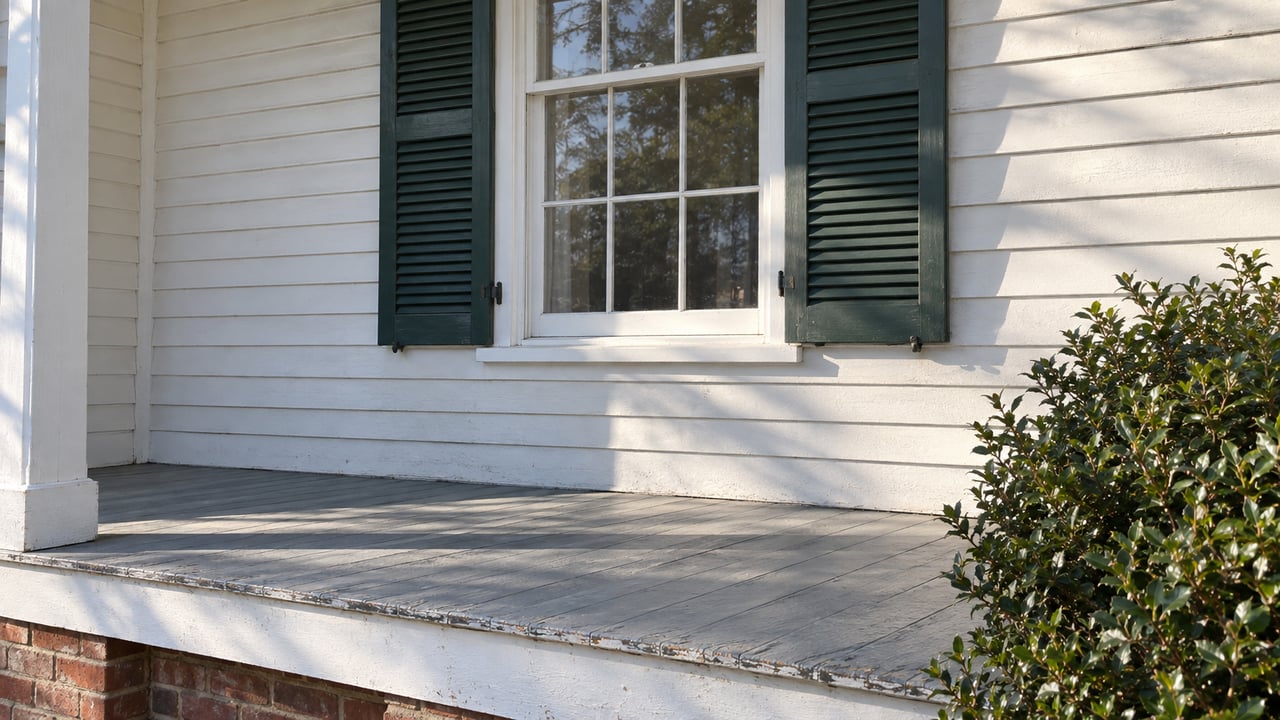
In Historic Swansboro, the National Register Listing Isn't What Controls Your Renovation
October 1, 2026
October 1, 2026
A 1950s ranch on a corner lot near downtown Swansboro goes under contract. The buyer knows the address sits inside the town's historic district, and assumes that because the house was built well after the district's oldest homes, it probably falls outside whatever review process governs the older places nearby. They plan to swap the vinyl gutters for something with more character and repaint the trim before move-in. Neither project needs a building permit by most people's definition of the word. Both need a Certificate of Appropriateness from the Town of Swansboro, and skipping that step doesn't just risk a fine. It can force the work to be undone.
That surprise is the whole story here. Swansboro's historic district doesn't sort homes by how old they look. It sorts them by whether they sit inside a boundary, and that boundary has almost nothing to do with the National Register listing most buyers assume is doing the regulating.
Downtown Swansboro carries two separate historic designations, and they don't share a footprint. One is the National Register-listed Swansboro Historic District, added to the register in 1990. The other is a locally designated historic district, created and enforced by the town itself. According to the North Carolina State Historic Preservation Office, these two boundaries overlap significantly but do not coincide, and the town partnered with the state in 2022 to update the architectural survey covering both.
The distinction that actually matters for a buyer: National Register listing by itself places no restriction on what an owner can do to their property. The University of North Carolina School of Government's Coates' Canons legal blog is direct on this point, noting that a private owner may alter, improve, or demolish a building listed in the National Register without any approval from the local, state, or federal government. It's the local designation that carries teeth. Once a town adopts a local historic district ordinance, an owner inside that boundary must get a Certificate of Appropriateness before making exterior changes, and that requirement comes from the zoning ordinance itself, not from the register listing.
So a home can be historically significant on paper and still be renovation-free of any town oversight, if it sits inside the National Register boundary but outside the local one. And a newer home nearby can carry real restrictions if it happens to fall inside the local district, regardless of what the National Register map says about it. Before writing an offer on anything downtown, the map that matters is the town's local historic district boundary, not the one filed with the National Park Service.
Inside the local district, Swansboro classifies structures as either Contributing or Non-contributing, and the cutoff is age. Town commission records put the line at homes built before 1938 for Contributing status, with anything built after classified as Non-contributing.
That distinction sounds like it should determine how much oversight a home faces. It doesn't. The town's own guidance is explicit that regulations apply within the historic district whether a home is considered Contributing or Non-contributing. A house built in 1975 gets the same exterior review as a house built in 1890, as long as both sit inside the local district boundary. The age classification affects how a proposed change gets evaluated against the district's character, not whether a Certificate of Appropriateness is required in the first place.
This is the detail that trips up buyers moving from areas without historic overlays. A newer home inside the boundary isn't a workaround. It's still subject to the same COA process as its older neighbors.
The line that matters isn't the home's age. It's whether the work touches the exterior. Under the town's ordinance, a Certificate of Appropriateness is required for any exterior building alteration, new construction, relocation, demolition, utility installation, dock installation, and substantial landscaping. The town's published list of examples includes:
Interior modifications don't require a COA, and neither does ordinary maintenance or in-kind replacement of a damaged feature using the same design and material. Replacing a rotted board with an identical board is maintenance. Replacing it with a different profile or material is a design change that needs review.
A separate and unrelated permit trigger sits alongside all of this. Per the town's guidance, any structural work, trade work such as electrical, mechanical, or plumbing, or any project exceeding $15,000 requires a standard building permit issued by the town, on top of whatever COA process applies. A kitchen remodel that stays entirely inside the walls still needs a normal permit once it crosses into structural or trade work. It just doesn't need historic review to go with it.
Swansboro's ordinance builds in a real penalty for doing exterior work first and asking permission later. Application fees are doubled for retroactive applications submitted after work has already begun or been completed, according to the town's fee schedule. Beyond the doubled fee, Preservation NC notes that a historic preservation commission has the authority to demand that a completed project be reversed if it's inconsistent with the district's design guidelines. That's not a hypothetical for a buyer weighing a fast turnaround before a move-in date. It's the actual downside of assuming a quick exterior fix falls under the radar.
Timing adds its own friction. Under the town's procedures, a completed COA application, along with supporting materials, must be submitted to the town administrator no less than 14 working days before the next regularly scheduled meeting of the Swansboro Historic Preservation Commission. For a buyer planning to close and immediately start exterior work, that lead time needs to be built into the renovation schedule from day one, not discovered after the movers have already left.
Not every project requires the full commission process. The town recognizes a category of "minor works," exterior changes judged to have no discernible impact on the district's character, which can be approved without going before the full commission. A buyer whose plans are limited to smaller cosmetic changes may be able to move through that faster track, but the determination of what qualifies as minor work is made by the town, not by the homeowner.
The same designation that adds review also opens a door most buyers don't think to ask about. The Town of Swansboro's own historic district guidance points owners toward North Carolina's State Historic Rehabilitation Tax Credit Program, which offers a 15 percent state tax credit for qualified rehabilitation of owner-occupied residential properties. The program is administered through the State Historic Preservation Office, and work must meet the Secretary of the Interior's Standards for Rehabilitation to qualify.
This isn't something a real estate closing resolves on its own, and it isn't tax advice. A buyer seriously weighing a rehab project on a Contributing structure downtown should raise it early with the State Historic Preservation Office and a tax professional, before finalizing renovation plans rather than after the work is already underway.
A few questions are worth asking before a downtown Swansboro home goes under contract:
None of these questions show up on a listing sheet. They come from a call to Swansboro Town Hall, and they're worth making before a renovation budget and timeline get built around assumptions that don't hold.
Does every home in downtown Swansboro require a Certificate of Appropriateness for renovations? Only homes inside the locally designated historic district boundary, which is not identical to the National Register district boundary. A home can be listed on the National Register without being subject to local COA review, and vice versa. Confirming which boundary applies to a specific address is a question for the town administrator.
If my home is Non-contributing because it was built after 1938, do I still need a COA? Yes. The town's guidance states that regulations apply whether a home is Contributing or Non-contributing. The age classification affects how a project is evaluated, not whether review is required.
Can I skip the process for interior renovations? Interior modifications and ordinary maintenance or in-kind replacement don't require a COA. Anything changing the exterior appearance, materials, or design typically does.
What happens if I do exterior work without a COA? Application fees are doubled for retroactive submissions, and the historic preservation commission has the authority to require that non-compliant work be reversed.
Buying inside historic Swansboro means budgeting for a second layer of review most buyers never encounter elsewhere, and knowing which map actually applies to your address before you plan a single exterior project. If you're weighing a home inside the district and want to understand what a specific address is actually subject to before you write an offer, Homes By Holly can walk through it with you.
Stay up to date on the latest real estate trends.


Buying, selling, or investing? Holly Griffith provides expert guidance, personalized service, and results that make a difference. Let’s turn your real estate goals into reality—contact Holly today!